
I’m a senior international studies and political science major, and a University Undergraduate Research Fellow. My research is “Bosnia’s ‘Incomplete’ Reconciliation Process and International Intervention During the Yugoslav Wars.”
When I applied for the University Undergraduate Research Fellowship I intended to extend my research from my First-Year Fellowship at the Sheridan Libraries, but the archives weren’t available and I had to pivot and come up with entirely new research.
I was taking a history class with Associate Teaching Professor Victoria Harms at the time called “Europe since 1945.” I was particularly intrigued by our readings about how the U.S. played a role in diplomatic decisions after World War II, and became really interested in former Yugoslavia and the Balkans. I wanted to understand how treaty law shaped the post-war environment in Bosnia, and how those changes shaped their history, borders, culture, and politics. I’m specifically studying the the Bosnian Wars and long-term impacts of the Dayton Peace Agreement which brought the immediate conflict to an end.
How intervention changes countries
Since I don’t speak Bosnian, Serbian, or Croatian (the three main languages of Bosnia), I focused on sources in English that depicted the role of the West in Yugoslavia. I began by reading secondary sources, such as former diplomats’ memoirs and publications about the goals for Bosnia in the 1990s. Professor Harms connected me with professors from around the world who were from the Balkans, or who studied the international criminal trials.
I focused on how many peace plans and interventions were designed to prevent ongoing conflict along ethnic lines, assuming that the only way to keep peace was to separate the ethnic groups. This follows a sort of primordial thinking that ethnic hatred is endemic and inevitable. My paper contests the idea that the wars were just an ethnic conflict and posits that that thinking created ineffective post-conflict acts and peace treaties, because they didn’t focus on the real, political sources of the conflict. The ethnic divisions that were enforced after the war undermined the unique multicultural unity that was found in Bosnia, and the former Yugoslavia, before the war.
Research in the field
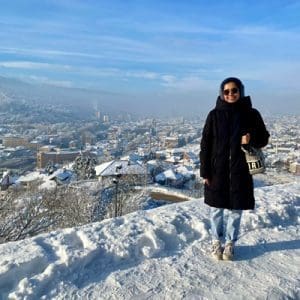
I wanted to have an authentic understanding of the conflict, so I made a three-week visit in winter 2024-2025. I went to museums and archives, like the National Archives in Sarajevo, and pored through wartime documents and newspapers. I spent a lot of time with the daily paper Oslobođenje, which was written for all three ethnic populations and in two languages. I was in the archives almost every day — translating as much as I could with my phone and making copies of the content that seemed most relevant to my work.
The newspapers included news, personal stories, and real-time maps to show how the post-conflict plans changed from day to day. I was also pleased to find a number of political cartoons. I had done research on political cartoons as part of my First-Year Fellowship, so I understand what visual culture can share with us about history and politics.
I also talked to many Bosnians to hear their own experiences. They included the mayor of Goražde, one of the cities under siege during the war, archivists, imams, historians, and community members near Srebrenica Memorial Center, where one of the largest genocides took place. I didn’t have IRB approval to record interviews at the time, but I wanted to create a connection with people and and create a channel so I could have structured interviews later. I needed to make personal connections first. This spring, I’ll conduct formal interviews with many of those people. I also hope to present at some undergraduate research conferences before graduation.
The value of research
Going to a country I knew very little about, beyond historical knowledge, was a really unique experience. It showed me the value of having conversations with people who were personally affected by the war and genocide. In the U.S., we use academic theories and frameworks to understand conflicts, but it’s a completely different situation when you talk to people. I better understood theories and agreements had tangible human impact on the ground.
I never thought I’d get to experience something like this. When I came to Johns Hopkins, I didn’t even expect to do research. I didn’t realize that an opportunity existed for the humanities like it does for sciences. This work has shown me that research is important, and integral, in fields like the social sciences and humanities.