
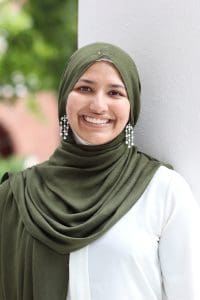
My project, funded by the Dr. Saraf Memorial Award, is called Mujhe Depression Hai: (Mis)translations and Mental Health Training in Pakistan. The goal of my research project is to ascertain whether teaching psychiatric diagnostic criteria in English instead of Urdu leads to an internal language barrier between the Urdu-speaking psychiatrist and patient, resulting in misdiagnosis, or lack of diagnoses.
Navigating the project
After I took a “Designing a Social Research Project” with Lecturer Valeria Procupez, I found that I wanted to do research in Pakistan on something about Urdu. Urdu is my mother tongue, and I have family that live in Pakistan so I know the area fairly well. The original plan was to go to Pakistan and do my research via participant observation, ethnography, and interviews. Due to unforeseen circumstances, I had to stay in the United States. Instead, I conducted virtual ethnography and interviews by meeting with faculty and Pakistani psychiatrists over zoom. I also flew out to California to interview a Pakistani-trained psychiatrist.
Since I was interviewing from the U.S., I had the unique ability to expand my research and talk to faculty and psychiatrists from a variety of Pakistani institutions. I spoke to faculty and alumni from Aga Khan University in Karachi and faculty from the University of Health Sciences in Lahore. I wanted to understand the kinds of words and phrases most commonly used by their patients to describe their symptoms, compared with the terms medical students use to determine if a patient’s symptoms meet diagnostic criteria. Are they using the same words? And do they understand each other?
My other methods include archival research, where I am looking into old Pakistani/South Asian psychiatric material. That has been an uphill battle. Because I’m not physically in Pakistan, it’s difficult to find any particularly old studies or textbooks. I have been using many older medical papers that came out of Pakistani institutions and have been able to ask my interlocutors for class materials.
Gaps in psychiatric education
Many educational systems around the world teach in a language different from the dominant social language due to colonization. If my research shows that this form of teaching significantly impacts diagnoses, it can be used to change medical education around the world.
My most interesting finding—which has changed the way I will be writing my thesis—is that there is a significant difference between how public and private medical schools teach psychiatry, if at all. Private universities often have students who plan on leaving Pakistan and practicing elsewhere, usually in the west. Thus, those schools conform more to western medical education. They do not teach much in Urdu, they require behavioral science courses and psychiatry rotations, and they test on psychiatric material.
Public universities, on the other hand, seem to have more students who plan to stay in Pakistan. These universities’ faculty have a vested interest in teaching students how to navigate healthcare in Urdu. I found that each university would have an internal pamphlet translating English psychiatry questions into Urdu. However, the same universities did not require behavioral science courses, psychiatry rotations, or test on any such material. Unless a student wants to be a psychiatrist, they can essentially go through medical school without learning anything but the basics of psychiatry and mental health.
Learning from the work
Teaching in English isn’t necessarily causing misdiagnoses, but it had led to a third learning space where psychiatrists are learning from experiences in the field or from one another. There’s no systematic or standardized way that psychiatrists are learning to treat specifically their patient population, which complicates the process for doctors and patients.
Regardless of the outcome, I learned a lot from the people I talked with, especially about how to engage in academia in an international context. Helping people can look many different ways. The faculty, especially, were only teaching because they wanted to ensure they passed on their knowledge and their students continued to help Pakistanis by raising awareness for mental health.
I am currently doing extra archival research to understand how the Pakistani medical educational system came to be and why the DSM is used in their schools. When it’s complete, I plan on submitting my thesis for publication in anthropological journals.