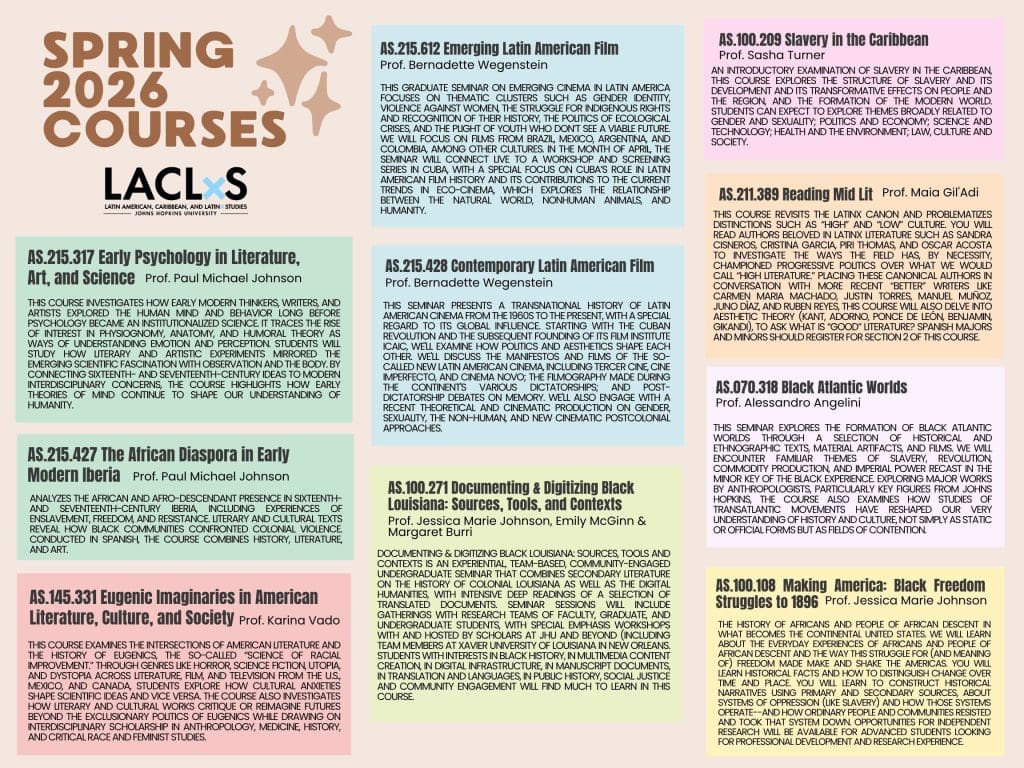
This spring, immerse yourself in courses that blend creativity and critical inquiry. LACLxS invites you to explore the rich intersections of literature, film, and science in the study of the Americas. The Spring 2026 curriculum highlights innovative approaches to race, culture, and thought across centuries and continents.
- AS.215.317 Early Psychology in Literature, Art, and Science: Although the modern discipline of psychology was not formalized until the late 1800s, the mind and human behavior had been subjects of intense curiosity for centuries. In early modern Europe, painters, physicians, philosophers, and writers of fiction explored the psychological dimensions of experience from manifold perspectives. The Renaissance brought a renewed interest in physiognomy and humoral theory, as well as the growth of anatomy, physiology, pharmacology, and practices of dissection and observation. Meanwhile, the literary and visual arts were also experimenting with new forms of understanding and representing interiority, the emotions, and mental faculties and illnesses. This undergraduate seminar will study these scientific and cultural movements before the consolidation of modern psychology, seeking to understand them within their sixteenth- and seventeenth-century milieus while establishing links with interdisciplinary concerns of today. Class will be conducted in Spanish. Taught in Spanish.
- AS.215.427 The African Diaspora in Early Modern Iberia: Sixteenth- and seventeenth-century Spain was home to a sizeable Black African, Afro-diasporic, and Afro-descendant population that scholarship has only recently begun to acknowledge substantively. The historical legacy of these communities reveals that Afro-Iberians, enslaved as well as free, experienced often violent forms of racial discrimination and oppression, but that they also contributed meaningfully to a shared cultural landscape of art, literature, drama, dance, and music. Early modern writers of fiction likewise depicted Afro-diasporic characters not only as servants but also as sovereigns, soldiers, scholars, and saints. This advanced undergraduate seminar will grapple with these ambivalences by surveying a wide, multidisciplinary range of cultural products. In surveying the historical and literary complexities of the African diaspora in early modern Iberia, we will ask how these communities were subjected to the violence of empire, colonialism, racism, human trafficking, and enslavement, while at the same time generating creative vectors of pride, freedom, agency, and resistance. Class will be conducted in Spanish.
- AS.215.428: Contemporary Latin American Film: This seminar presents a transnational history of Latin American cinema from the 1960s to the present, with a special regard to its global influence. Starting with the Cuban Revolution and the subsequent founding of its film institute ICAIC, we’ll examine how politics and aesthetics shape each other. We’ll discuss the manifestos and films of the so-called New Latin American Cinema, including Tercer Cine, Cine Imperfecto, and Cinema Novo; the filmography made during the continent’s various dictatorships; and post-dictatorship debates on memory. We’ll also engage with a recent theoretical and cinematic production on gender, sexuality, the non-human, and new cinematic postcolonial approaches.
- AS.211.389 Reading Mid Lit: This course revisits the Latinx canon and problematizes distinctions such as “high” and “low” culture. You will read authors beloved in Latinx literature such as Sandra Cisneros, Cristina Garcia, Piri Thomas, and Oscar Acosta to investigate the ways the field has, by necessity, championed progressive politics over what we would call “high literature.” Placing these canonical authors in conversation with more recent “better” writers like Carmen Maria Machado, Justin Torres, Manuel Muñoz, Juno Díaz, and Ruben Reyes, this course will also delve into aesthetic theory (Kant, Adorno, Ponce de León, Benjamin, Gikandi), to ask what is “good” literature? Spanish Majors and Minors should register for Section 2 of this course.
- AS.215.612 Emerging Latin American Cinema: This graduate seminar on emerging cinema in Latin America focuses on thematic clusters such as gender identity, violence against women, the struggle for indigenous rights and recognition of their history, the politics of ecological crises, and the plight of youth who don’t see a viable future. We will focus on films from Brazil, Mexico, Argentina, and Colombia, among other cultures. In the month of April, the seminar will connect live to a workshop and screening series in Cuba, with a special focus on Cuba’s role in Latin American Film history and its contributions to the current trends in eco-cinema, which explores the relationship between the natural world, nonhuman animals, and humanity.
- AS.100.108 Making America: Black Freedom Struggles to 1896: The history of Africans and people of African descent in what becomes the continental United States. We will learn about the everyday experiences of Africans and people of African descent and the way this struggle for (and meaning of) freedom made make and shake the Americas. You will learn historical facts and how to distinguish change over time and place. You will learn to construct historical narratives using primary and secondary sources, about systems of oppression (like slavery) and how those systems operate–and how ordinary people and communities resisted and took that system down. Opportunities for independent research will be available for advanced students looking for professional development and research experience.
- AS.100.209 Slavery in the Caribbean: An introductory examination of slavery in the Caribbean, this course explores the structure of slavery and its development and its transformative effects on people and the region, and the formation of the modern world. Students can expect to explore themes broadly related to gender and sexuality; politics and economy; science and technology; health and the environment; law, culture and society.
- AS.100.271 Documenting & Digitizing Black Louisiana: Sources, Tools, and Contexts: Documenting & Digitizing Black Louisiana: Sources, Tools and Contexts is an experiential, team-based, community-engaged undergraduate seminar that combines secondary literature on the history of colonial Louisiana as well as the digital humanities, with intensive deep readings of a selection of translated documents. Seminar sessions will include gatherings with research teams of faculty, graduate, and undergraduate students, with special emphasis workshops with and hosted by scholars at JHU and beyond (including team members at Xavier University of Louisiana in New Orleans. Students with interests in Black history, in multimedia content creation, in digital infrastructure, in manuscript documents, in translation and languages, in public history, social justice and community engagement will find much to learn in this course.
- AS.145.331 Eugenic Imaginaries in American Literature, Culture, and Society: In this course, we will explore the intersections of American literature, broadly conceived, and eugenics. Defined as the “[pseudo]science of racial improvement,” eugenics gained global traction amongst scientists, physicians, politicians (both liberal and conservative), intellectuals, writers, and the general public in the late nineteenth and early twentieth centuries. Engaging genres such as horror, sci-fi, utopian and dystopian fiction, and textual mediums such as novels, poetry, television, and film from the US, Mexico, and Canada, we will thus consider how social and cultural anxieties and ideas shape scientific practice and how scientific ideas inform literary and cultural imaginaries. At the same time, we will be paying special attention to how these literary and cultural texts affirm, critique, revise, or conjure futures beyond the horrors of eugenics and its destructive politics of exclusion. Considering, then, the many genealogies of eugenics, we will supplement our primary readings with excerpts of texts that shaped the makings of eugenics, legitimated it as an interdisciplinary scientific field, and that later served as springboards for the implementation of eugenic policy. Further, we will engage scholarship in the fields of anthropology, history of medicine, history of science, sociology, science and technology studies (especially critical race, feminist, and postcolonial approaches), and the medical humanities. Through these and other texts, we will also critically survey the lingering afterlives or legacies of eugenic thought that inform contemporary questions of classification, “fit” and “unfit” bodies, death and dying, illness and health, and social identity (ex. class, disability, gender, race, and sexuality).”
- AS.070.318 Black Atlantic Worlds: This seminar explores the formation of Black Atlantic worlds through a selection of historical and ethnographic texts, material artifacts, and films. We will encounter familiar themes of slavery, revolution, commodity production, and imperial power recast in the minor key of the Black experience. Exploring major works by anthropologists, particularly key figures from Johns Hopkins, the course also examines how studies of transatlantic movements have reshaped our very understanding of history and culture, not simply as static or official forms but as fields of contention.