
The Zanvyl Krieger School of Arts and Sciences is the core institution of Johns Hopkins University’s Homewood campus. Founded in 1876, Johns Hopkins was established as the nation’s first research university.
Today, each of the Krieger School’s faculty members is expected to spend as much time on research as on teaching. As a result, inquiry and the creation of new knowledge are the engine and fuel that drive teaching and learning in the school.
The Krieger School is comprised of 23 departments and 33 centers, programs, and institutes, and home to students interested in the arts, humanities, natural sciences, and social sciences. Christopher S. Celenza was named dean in January 2021. Our mission is discovery—the creation of new knowledge through research and scholarship, and the education of our students, undergraduate and graduate alike.
The Krieger School offers comprehensive undergraduate and graduate education at the core of the Johns Hopkins complex of schools, centers, and institutes. More than 150 years after the University opened, the Krieger School of Arts and Sciences still follows the guiding principles of Hopkins’s visionary first president, Daniel Coit Gilman, which position the school at the forefront of knowledge.
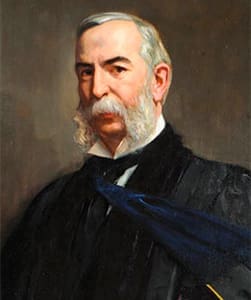
The best teachers are usually those who are free, competent, and willing to make original researches in the library and the laboratory.
President Daniel Coit Gilman
The best investigators are usually those who have also the responsibilities of instruction, gaining thus the incitement of colleagues, the encouragement of pupils, the observation of the public.

Dedication of Gilman Hall, May 21, 1915. Photo: JHU Special Collections.
History
The plan that Gilman devised and began to carry out in 1876 established Johns Hopkins as the nation’s first research university—that is, an institution in which every faculty member was actively engaged in original investigations. Gilman dismissed the notion that teaching and research are separate endeavors; he believed that success in one depended on success in the other.
The realization of Gilman’s philosophy at Hopkins, and at other institutions that later attracted Hopkins-trained scholars, revolutionized higher education in America, leading to the modern research university system.
Johns Hopkins has been responding to the world’s needs since its inception in 1876. The Krieger School is uniquely situated to build on that tradition by providing research opportunities to students in all disciplines as early as their first year and by creating innovative partnerships with the other divisions of the university.
Our simple aim is to make scholars, strong, bright, useful, and true.
President Daniel Coit Gilman
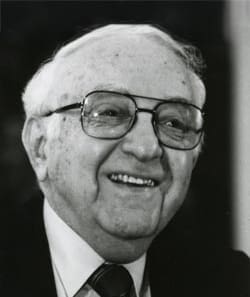
Zanvyl Krieger
Krieger was a life-long Baltimorean with committed civic ties. He played an ownership role in both the Baltimore Orioles and the Baltimore Colts. His charitable concerns included the Krieger Children’s Eye Center at Johns Hopkins’ Wilmer Ophthalmological Institute; the United States Holocaust Memorial Museum; the Kennedy Krieger Institute, a world-renowned clinic for children with disabilities; and the Krieger Mind/Brain Institute at Johns Hopkins’ Homewood campus. Krieger was a graduate of Baltimore City College, Johns Hopkins University, and Harvard Law School. He was the key investor in U.S. Surgical, which owned the rights to a method for closing surgical incisions without cloth fiber stitches. This sagacious investment allowed Krieger to move from civic involvement to epic philanthropy.
By turns a distiller, a lawyer, and an extremely successful business entrepreneur, Zanvyl Krieger made his name best known as an extraordinary philanthropist. His greatest single gift was a $50 million challenge grant, made in 1992, to the School of Arts and Sciences of the Johns Hopkins University. The gift is one of the largest ever directed exclusively to a U.S. school or college of arts and sciences. To pay fitting tribute, Hopkins renamed its core institution, so that it is now the Zanvyl Krieger School of Arts and Sciences and awarded Krieger an honorary doctorate of humane letters.