Promote public-facing scholarship and community engagement
We are building new channels for Krieger School faculty to share their work with, and engage, a variety of publics. The influence of our research extends beyond the university as we translate it into terms meaningful for society and work with partners outside Johns Hopkins to produce new knowledge. These strategies help build trust with the citizens of Baltimore and Washington, D.C., even as they increase our participation in the communities in which we live and work.
Our strategies
Promote public scholarship in all fields.
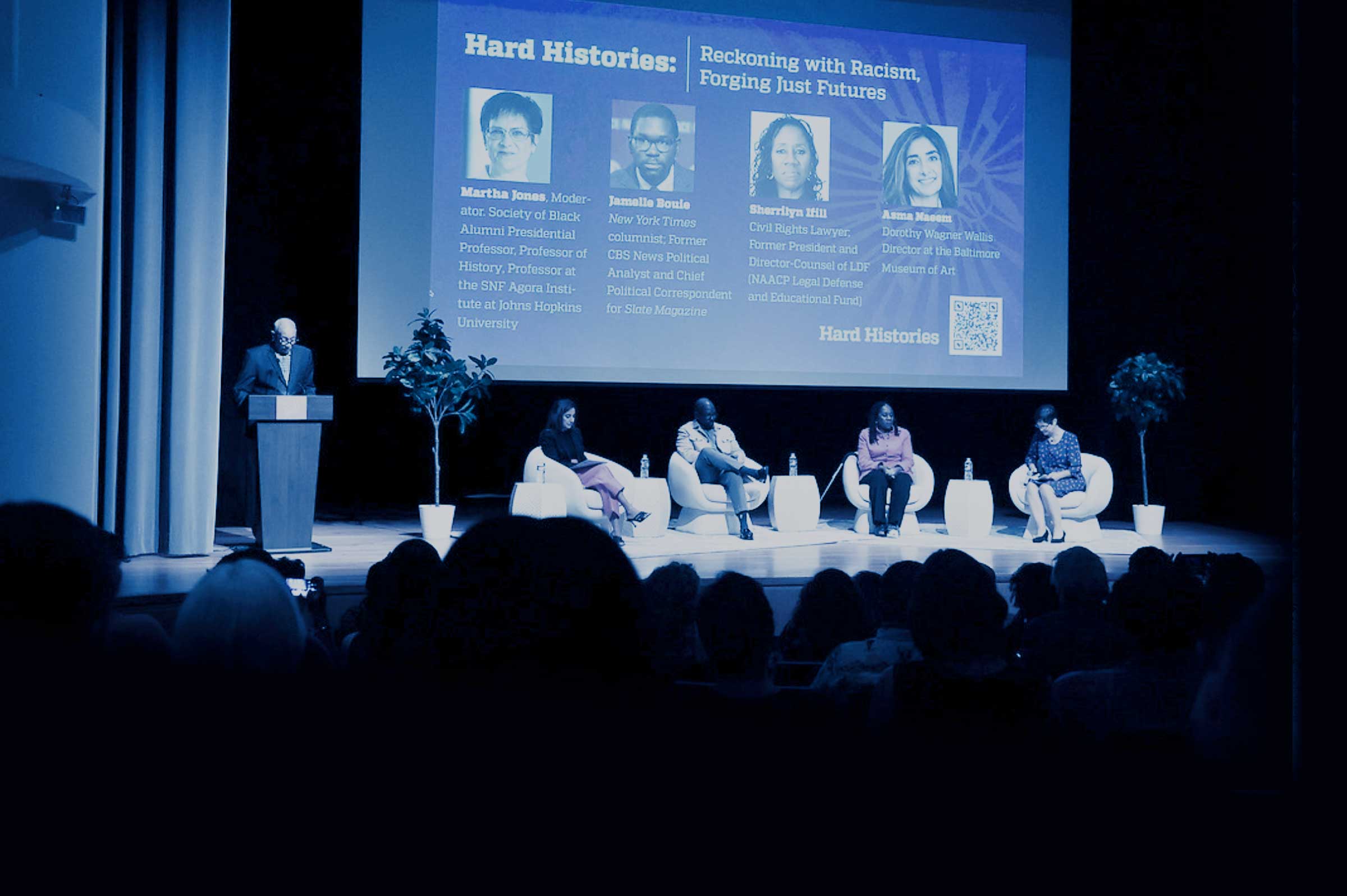
It is more important than ever for our faculty to share stories of their expertise far and wide. Krieger School faculty have a vigorous presence in the university’s campaign to explain the purpose and impact of basic science. Within KSAS, programs such as the Humanities in the Village and Humanities on the Mall series permit faculty voices to reach beyond the walls of our campus. Partnerships like those with Johns Hopkins Technology Ventures and the Space Telescope Science Institute, open trajectories for the broad translation of research programs. Via path-breaking methodologies, exemplified in the Baltimore Social-Environmental Collaborative and the 21st Century Cities Initiative, our faculty are activating community partnerships in research that responds to community needs.
Encourage community engagement in the cities of Baltimore and Washington, D.C.
The Krieger School continues to expand its engagement with the city of Baltimore and build its presence in Washington, D.C. Engagement takes the form of organizational and institutional partnerships with museums, K-12 schools, independent bookstores, and nonprofits; it happens via faculty-led research projects in numerous disciplines. Partnerships and collaborative community-based research also hold opportunities to train Krieger School undergraduate and graduate students in community-engaged scholarship.
Educate Krieger School faculty and students in methods of public scholarship.
The Krieger School will continue to provide resources and media training to translate the expertise of our scholars and scientists for other audiences. We will seek other opportunities to teach faculty members and graduate students creative ways to bring their scholarship to the public beyond the walls of the university.
Expand our educational registers to promote democracy and intellectual pluralism.
Engaged scholarship requires exploring and teaching multiple perspectives. Through the SNF Agora Institute, the Krieger School is expanding the academic pathways and co-curricular opportunities for students to study civic thought. We will bring heightened cross-disciplinary focus to guiding students through the evolution of foundational ideas from antiquity to the present. Research collaborations with scholars at the American Enterprise Institute open venues for Krieger School faculty to engage new publics. We also aim to develop meaningful connections between scholarship in the arts and sciences and the new School for Government and Policy.
Our accomplishments
2024-2025
Building audiences in Washington, D.C.
In 2024-25, the Krieger School of Arts and Sciences participated in a variety of activities at the Johns Hopkins Bloomberg Center. In addition to the two Hopkins Semesters D.C. offered this academic year, KSAS faculty were part of 10 Nexus Awards, which resulted in public events, professional convenings, and courses that highlighted expertise in the Krieger School. We also hosted all manner of programming including the second debate in The Hopkins Forum on the U.S.-China AI arms race, sponsored by the SNF Agora Institute; the Humanities on the Hill series, sponsored by the Alexander Grass Humanities Institute; and a new film series called Stories That Matter, sponsored by the Master of Arts in Film and Media program.
Engaging with the city of Baltimore
The Fall 2024 issue of Arts & Sciences Magazine featured the work that many KSAS departments and faculty do in Baltimore and with Baltimoreans. To these ongoing projects, new initiatives were added during 2024-25. For example, KSAS researchers joined forces with curators at the B&O Railroad Museum to use AI to help them digitize the massive database of employee records dating back to the early 1900s. The Baltimore Area Survey—developed and administered by faculty in the Krieger School’s 21st Century Cities Initiative—garnered local and national publicity with findings from its second annual survey and report. In addition, KSAS faculty and students collaborated with local artists and the Peale Museum to curate an exhibition of materials gathered along the Jones Falls River as an examination of what humans leave behind.
Leading national conversations
The Krieger School aims to elevate its status as a leader in various disciplines across the humanities, social sciences, and natural sciences by sparking national conversations about today’s pressing issues and big questions. In spring 2025, the Dean’s Office and Alexander Grass Humanities Institute sponsored a series of online discussions, titled Conflict in the Middle East, to explore the longstanding tensions between Israel and Palestine, the political and social implications for both sides, and the broader regional and international impact. A parallel undergraduate course based on the series garnered a waitlist. The Krieger School helped to forge a university partnership with the American Enterprise Institute—a public policy think tank—as part of the university’s broader efforts to engage with a wide range of institutions, especially in Washington, D.C., on questions of public concern. Faculty in the William H. Miller III Departments of Philosophy and Physics and Astronomy held an international conference to bring together researchers from a variety of disciplines to think about the universe in a systematic way.
Bringing KSAS scholarship to the public arena
The research of several of our natural scientists has been featured in the university-wide campaign known as Research Saves Lives and we anticipate that this stream of engagement will continue. In addition, in partnership with the Krieger School Advisory Board, the Dean’s office examined the various communications avenues we use to share news about KSAS faculty with broad audiences, which resulted in several recommendations to increase our reach. This includes efforts to train faculty in media engagement. In 2024-25, three Krieger School faculty were among the first cohort of Provost’s Fellows for Public Engagement. The Krieger School Office of Communications also planned and facilitated media and op-ed training for faculty with the 21st Century Cities Initiative.
2023-2024
Public scholarship in the social sciences
During the past academic year, the SNF Agora Institute introduced two new programs of study through its Center for Economy and Society. In fall 2023, they launched a new minor in Civic Life, to prepare students from all areas of study to be engaged global citizens. In spring 2024, they launched a new major in Moral and Political Economy, that trains students to think about economic problems in social, cultural, moral, and political contexts.
Community engagement in Baltimore
- In December 2023, the 21st Century Cities Initiative published the results of the Baltimore Area Survey, its first annual, representative survey of Baltimore City and Baltimore County residents. Key findings relate to food insecurity, policing, transportation, drug addiction, neighborhoods, public trust, and entrepreneurship.
- The Krieger School strengthened community ties in collaboration with the Center for Social Concern. KSAS extended the grants for the six faculty who participated in the Engaged Scholar Faculty and Community Partner Fellowship Program to continue community-based teaching efforts.
- In December 2023, the Krieger School signed a Memorandum of Understanding with the Baltimore Museum of Art aimed at building awareness of the two institutions, enhancing curricular collaborations, and fostering opportunities for research collaborations. Over this academic year, the BMA hosted 108 guided class visits, compared to 39 in the previous academic year.
Public scholarship in the humanities and the arts
With support through the university’s Nexus Awards, the Alexander Grass Humanities Institute (AGHI) expanded its reach into the national capital through a new series titled Humanities on the Mall. Through this endeavor, AGHI partners with D.C.’s East City Bookshop to create a place to convene conversations about lively and important ideas. In addition, AGHI extended the successful Richard Macksey Lecture to host a D.C.-based event and the annual Homewood event.
Public scholarship in the natural sciences
The Cosmic Visions project has created opportunities to probe the history, philosophy, politics, and aesthetics of the humanistic and scientific view of the cosmos. A three-year Johns Hopkins Discovery Award, combined with additional funding from the AGHI, enables the Cosmic Visions program to host an annual conference that brings humanists and scientists together on the Homewood campus to focus on discoveries and questions about findings from the mes, Politico, Nature, and The Washington Post.