

- This event has passed.
Body Work, Biohacking and the Enslaved Boy in the Roman Empire
October 23 @ 4:30 pm - 6:00 pm
@
JHU Classics presents a lecture by Dr. Evan Jewell, Assistant Professor of History, Rutgers University – Camden
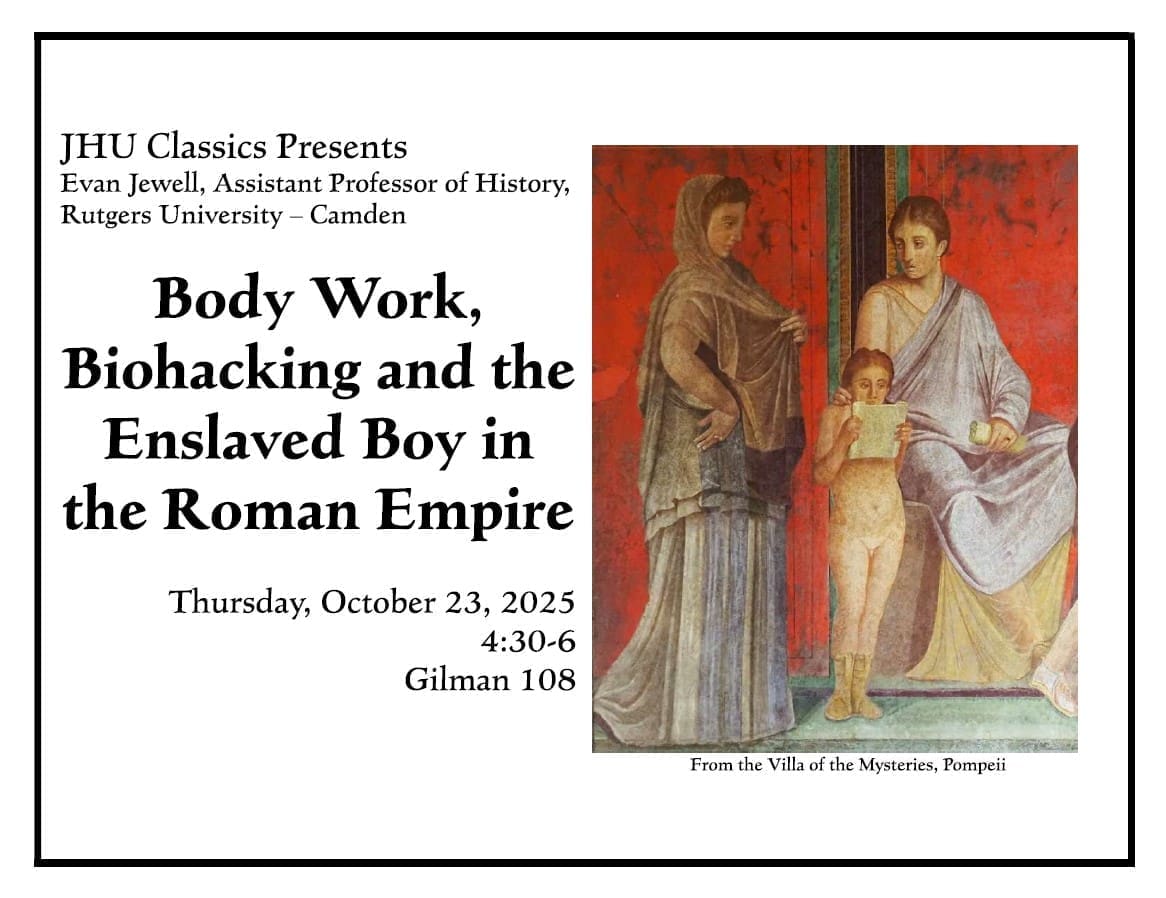
In the Roman world, the desirability and penetrability of the enslaved puer or “boy”, was often predicated on their perceived youthfulness or effeminacy, and whether they had passed out of puberty and into mature manhood. The body of the enslaved puer was therefore frequently the object of autopsy, from the slave market platform to the bedroom, where the greatest determinant of desire or disgust lay in the absence or presence of body hair. As well established as this corporeal reality has become in scholarship, the sexualized, aestheticized body of the enslaved boy has not figured as a serious site of consideration for the deployment of technologies in an enslaver’s “strategies” and the enslaved’s “tactics”, following Joshel’s and Petersen’s (2014) useful adaptation of de Certeau for Roman contexts of slavery. Building on work exploring ideas of “body modification”, for example, in the construction of the ideal, athletic body in classical Greece (Lee 2009), this paper seeks to push the envelope further, drawing on the contemporary sociological theory of “body work” (e.g., Gimlin 2007) to assess how the corpus of the enslaved puer could be worked upon, both by the puer himself and his enslaver, to escape or perpetuate his somatic puerility and the forms of forced (often sex) work which were tied to the perception of his body. That some enslaved boys may have attempted to accelerate their ageing process (e.g. Trimalchio in Petronius’ Satyrica: Pomeroy 1992, Bielfeldt 2018), while others attempted to delay it with all manner of imbibed and applied concoctions, points to how the enslaved and the enslaver not only performed body work, but, in their specifically medicinal, technological approaches to the boy’s youthful appearance, they might even be said to have attempted to “biohack” the body of the boy—well before the term was developed to contend with contemporary discussions around hormones, trans* experience and cyborg embodiment (Malatino 2017). Finally, by considering the overarching framework of slavery in which this body work and biohacking played out, the resemblance between the corporeal work performed upon the boy (puer) and that on the book (liber)—two commodities that were often conflated and entangled with each other in terms of labor—demonstrates how the technologies deployed by this matrix of domination could make two very different corpora analogous.
References:
Bielfeldt, R. (2018), “Candelabrus and Trimalchio: Embodied Histories of Roman Lampstands and their Slaves,” Art History 41: 420-43.
Gimlin, D. (2007), “What is ‘Body Work’? A Review of the Literature,” Sociology Compass 1: 353–70.
Joshel, S. and Hackworth Petersen, L. (2014), The Material Life of Roman Slaves. Cambridge.
Lee, M.M. (2009), “Body-Modification in Classical Greece,” in Fögen, T. and Lee, M.M. (eds), Bodies and Boundaries in Graeco-Roman Antiquity, Berlin: 155-80.
Malatino, H. (2017), “Biohacking Gender,” Angelaki: The Journal of Theoretical Humanities 22: 179-90.
Pomeroy, A.J. (1992), “Trimalchio as Deliciae,” Phoenix 46: 45–53.