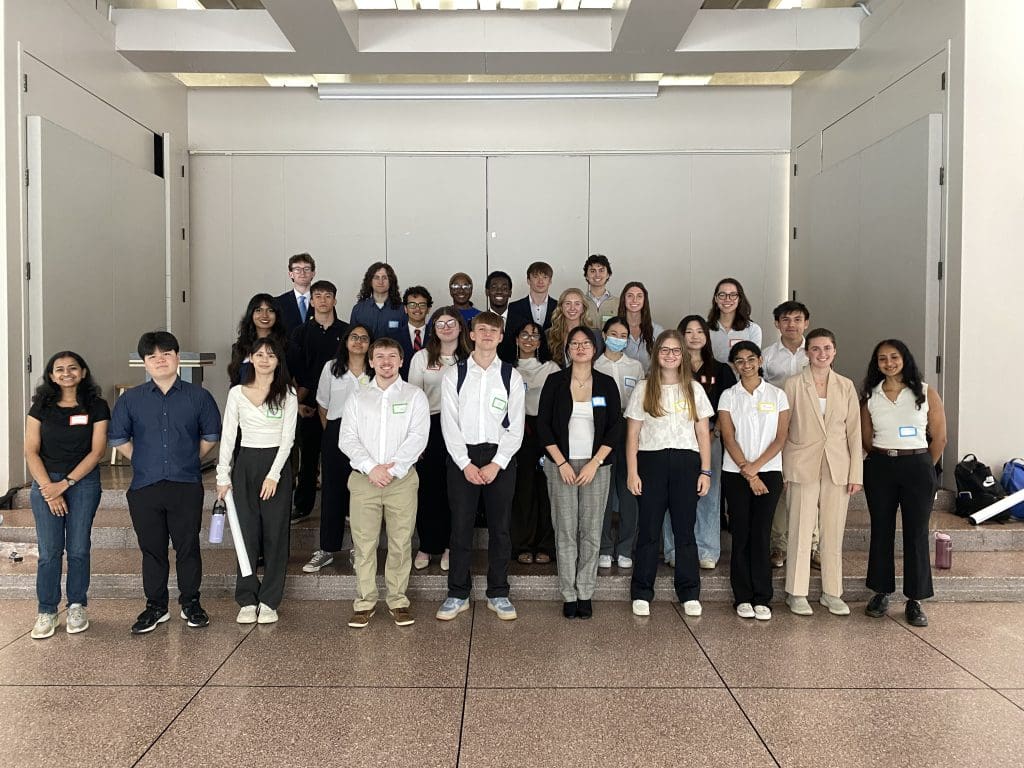
A special thanks to Max Keller and URSCA for administrative programming and support! And to our JHU and JHMI Faculty Mentors and their labs.
Undergraduate students presented their research to an excited audience of peers, mentors, and faculty. Thank you for helping us celebrate our student researchers and their academic pursuits. Please see below their abstracts, listed with full authors.
1. Serotonin Transporter Dysfunction Exacerbates Emotional Response to Hearing Loss in Mice Suhani Aggarwal, Sergio Vicencio-Jimenez, Ye-Hyun Kim, Katrina Schrode and Amanda Lauer
Serotonin is a neuromodulator involved in mood and anxiety disorders. Serotonergic dysregulation has been linked to distressing auditory conditions; however, the causal relationship between the two remains elusive. In this study, we examined anxiety-like behavior in serotonin transporter knock-out (SERT-KO) mice before and after noise-induced hearing loss. We used the open field test to measure freezing behavior as a proxy for anxiety-like behavior. Before noise exposure, freezing times were comparable across SERT-KO, SERT heterozygote, and wild-type mice. After noise exposure, only SERT-KOs had significantly increased freezing time, implying increased anxiety. Our results show that SERT gene deletion increases susceptibility to anxiety after hearing loss and suggest that serotonin may modulate emotional responses to auditory dysfunction.
2. Characterization of SOCS3-Like Protein Function and PPI Networks via Turboid Proximity Labeling Donata Amineva, Jared Tangeman, Seth Blackshaw
The axolotl exhibits extensive capabilities for regeneration, making it a critical model for studying injury induced retinal regeneration. From previous scRNA-seq studies, a SOCS3-like gene had been identified as one of the potential key drivers of regeneration in axolotls. The SOCS3-like protein is a novel axolotl protein that has structural similarity to the mouse SOCS3 protein. In order to assess the function of the SOCS3-like protein and identify key markers of its involvement in regeneration, we created a lentiviral construct knocking in SOCS3-like protein fused to TurboID into HEK293T cells in order to identify SOCS3-like PPI networks. We designed CRISPR knock-out gRNAs for knocking out the SOCS3-like gene in axolotls. It is anticipated that the generated animals will not regenerate in response to injury following the knock-out.
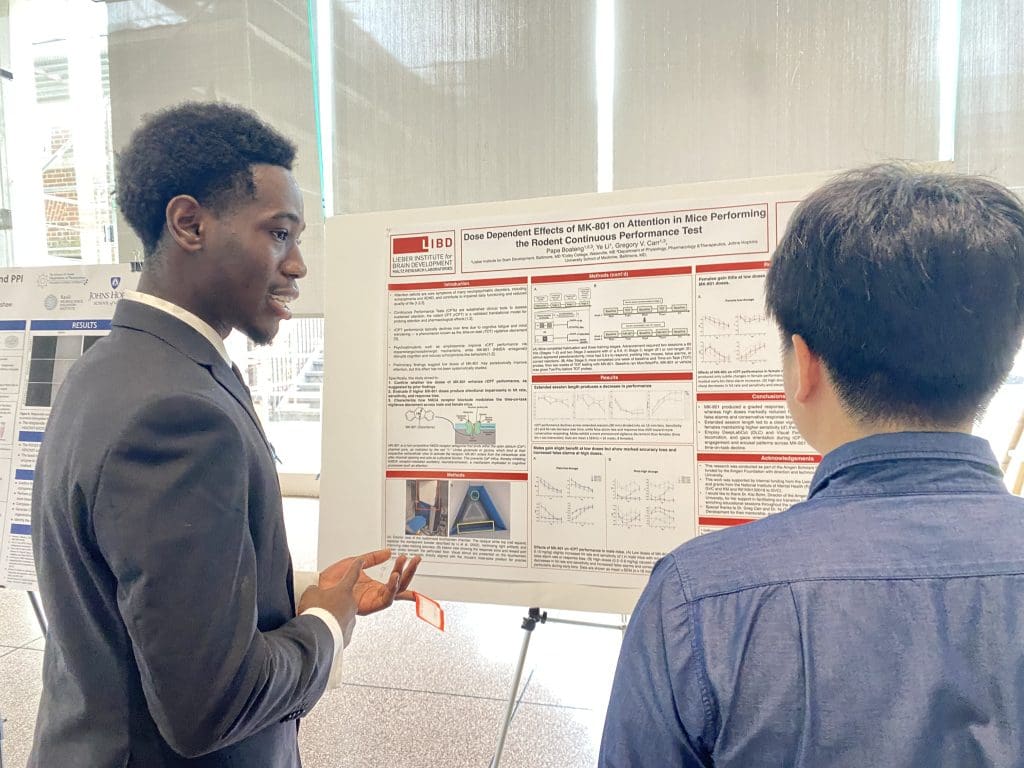
3. Dose Dependent Effects of MK-801 on Attention in Mice Performing the Rodent Continuous Performance Test Papa Boateng, Ye (Tyler) Li, Gregory Carr
Sustained attention deficits are a hallmark of neuropsychiatric disorders. The rodent Continuous Performance Test (rCPT) models this cognitive domain, focusing on vigilance over time-on-task (TOT). While NMDA receptor antagonists like MK-801 impair cognition in other behavioral tasks, their effects on rCPT performance remain untested. We aimed to determine whether MK-801 disrupts vigilance as measured by the rCPT. Using two cohorts, we assessed both low doses (previously shown to improve performance) and higher doses to identify thresholds for impairment. Preliminary results suggest a biphasic dose-response, with low doses enhancing and high doses impairing attention. These findings inform the utility of MK-801 in modeling attentional dysfunction and validate the rCPT as a sensitive tool for pharmacological screening.
4. Investigation of Haptic Illusory Percepts from the Mirror Brush Illusion in the Physical and Virtual World Ethan Brown, Lyndah Lovell, Jeremy Brown
Haptic feedback, derived from touch and proprioception, is essential for motor control and dexterity. These qualities are often compromised in individuals with limb loss or sensorimotor impairments. To enhance sensation in such populations, haptic illusions have emerged as a promising noninvasive strategy, leveraging visuo-haptic conflicts to evoke illusory haptic percepts. We developed the mirror-brush illusion, which involves viewing a mirror reflection of one hand while the other is occluded, and using brushes to deliver incongruent brushstrokes to both hands. This conflict leads to embodiment of the mirrored hand and false sensations on the occluded hand. We employ fNIRS to investigate brain activity during this illusion in both real-world and VR settings. This study can inform rehabilitative therapies for sensorimotor improvement.
5. Assessing Shape-Discrimination Abilities of Ferrets Maricelis Casillas-Pérez, Kristina J. Nielsen
Ferrets are valuable models for visual development research due to their rapid early maturation and postnatal accessibility. This study trains ferrets on basic shape-discrimination tasks using geometric shapes with linear features. Phase I evaluates their ability to distinguish between two basic shapes. In Phase II, ferrets train on shapes differing in curvature. Water reward amounts are adjusted to encourage balanced sampling and reduce response bias; block trials are introduced if alternating patterns emerge. Ferrets are expected to discriminate in a feature-independent manner, with rapid improvement across sessions even as shape parameters vary. Integrating varied features, this study aims to deepen understanding of ferret visual abilities to inform future studies, including those of visual cortex function.
6. Engineering VEGF/Erbb Dual Antagonist Proteins for Multifaceted Antitumor Therapy Santiago Christ, Amelia C. McCue, Jamie Spangler
Cancer progression is driven by complex signaling networks that promote uncontrolled cell proliferation and angiogenesis. In particular, HER2 overexpression and VEGF-mediated vascularization are hallmarks of aggressive tumors. This project explores the development of a bifunctional fusion protein engineered to both inhibit tumor growth and suppress angiogenesis. The therapeutic construct combines anti-HER2 binding domains with anti-VEGF domains, enabling simultaneous recruitment of natural killer (NK) cells to tumor cells and sequestration of VEGF ligands. Protein binding assays using CD16, a key NK cell receptor, and WST cytotoxicity assays were employed to evaluate the fusion protein’s inhibition of HER2 pathways. Future directions include a co-culturing assay with VEGF ligands present and in-vivo testing with mice HER2 receptors.
7. The Effects of Torpor on Associative Memory in Big Brown Bats John Cole, Magdiel Jaroszewski, Davi Drieskens, Nick Hwang, Nikita Finger, Cynthia Moss
Big brown bats (Eptesicus fuscus) undergo seasonal torpor from October to February, during which they reduce food and water intake and experience a ~15°C drop in body temperature. Little is known about how associative memories are retained across this period of metabolic suppression. Bats were trained on a maze task involving the identification of an auditory and visual cue. After reaching a success threshold across trials, the bats were divided into torpor and non-torpor groups. The bats in the torpor condition were housed in a 7°C environment while the non-torpor bats were in a 24°C environment. The bats remained under these conditions for three months before being retested on the task. Behavioral performance was analyzed using DeepLabCut. This study provides initial evidence that associative memory can persist through extended torpor.
8. The Mechanisms and Systematic Treatment Types of Pheochromocytoma Paraganglioma Imani Ghosh, Jaydi Del Rivero
Metastatic or unresectable pheochromocytomas and paragangliomas (PPGLs) are rare neuroendocrine tumors with limited treatment options. Systemic therapies such as somatostatin analogs (octreotide, lanreotide), peptide receptor radionuclide therapy (PRRT) with 177Lu-DOTATATE, chemotherapy (CVD, temozolomide), radioligand therapy (131I-MIBG), and tyrosine kinase inhibitors (sunitinib, cabozantinib) have shown varying benefits. Patients with SDHB mutations, associated with aggressive disease, may respond better to temozolomide and PRRT. PRRT and TKIs offer promise in disease control and progression-free survival. Further research is needed to evaluate optimal treatment sequencing, biomarker-driven therapy, and combination regimens to improve outcomes in advanced PPGL.
9. Investigating the Role of Sensory Neurons in Sleep Induction using a CFA-Induced Inflammatory Pain Mouse Model Shreesha Halder, Alban Latremoliere, Chloe Alexandre
Systemic inflammation increases sleep and causes fever, yet the effects of localized inflammation on sleep are unknown. We investigated this by implanting mice with EEG/EMG electrodes to record sleep and injected them intraplantarly with complete Freund’s adjuvant (CFA), which causes local inflammation and pain. We found that mice slept more without fever. Sciatic nerve transection reduced the effects of CFA when injected in the denervated hindpaw, but the injection in the contralateral paw resulted in a greater increase. In contrast, blocking circulating cytokine TNF-α by neutralizing antibody systemic treatment did not prevent CFA-induced increase in sleep. Thus, this elucidates that sensory neurons activated by peripheral inflammation are responsible for this increase in sleep while proinflammatory cytokines are likely not involved.
10. Conveying Disorder: Facilitating Access to Formation Descriptors for High-entropy Materials Discovery Connor Hoy, Jaehyung Lee, Corey Oses
The experimentation involved in novel solid-state materials development is often lengthy, arduous, and waste-intensive. The AFLOW software framework addresses this challenge computationally, making a priori predictions of compound properties for public use. A key feature of AFLOW is the calculation of formation descriptors, numerical measures of a material’s practical synthesizability. One such descriptor, the Disordered Entropy-Enthalpy Descriptor (DEED), has shown remarkable success in the discovery of high entropy carbides, carbonitrides, and borides. While DEED shows great potential for materials exploration, their calculation draws on a wide variety of data, with no workflow to facilitate the collection process. To amend this, a system was developed to automatically calculate, store, and retrieve DEED values within the AFLOW codebase.
11. Event Boundaries Set by Human Judgement Compared to Sentence Variabilities Veronica Hyeyoon Jung, Samira Tavassoli, Janice Chen
Previous studies on event boundaries of stories show that neural patterns are often segmented into events, and that these event boundaries can be detected via observation of these patterns. With seven flash fiction stories created by writers in Baltimore, USE (Universal Sentence Encoder) and Python were utilized to conduct a semantic centrality analysis for each story. Then, a study was conducted with participants setting personalized event boundaries for a story. To ensure that these participants understood the story, comprehension questions were given prior to the event segmentation task. Subsequently, a Python plot was created, showing the agreement distribution of event boundaries for each story. Finally, a comparison between semantic differences in stories and event boundaries set by participants was made.
12. Determining How MEIS2 Regulates Cell Fates in Human Retinal Organoids Alessia Iannuzzi, Allison Taylor, Robert Johnston
I am currently exploring mechanisms governing how starburst amacrine cells (SACs) and retinal ganglion cells (RGCs) are generated in human stem cell-derived retinal organoids. RNA sequencing of the human retina indicates that MEIS2, an important retinal gene regulator, is expressed in a subset of SACs. To validate the RNAseq results, I conducted a stain of MEIS2 and ChAT, a SAC marker, in retinal organoids. I did not observe MEIS2+ SACS. Instead, I found that MEIS2+ cells localized to the inner nuclear layer, the layer composed of mostly retinal ganglion cells (RGCs). Further single-cell RNA analysis and immunohistochemistry validated that MEIS2 is expressed in a subset of RGCs. To test the role of MEIS2 in RGC specification, I am generating a MEIS2 knockout stem cell line and will differentiate retinal organoids.
13. Impact of Auditory Sensory Deprivation on Visual System Performance and Cross-Modal Plasticity Rina Jeong, Katie Pham, Hey-Kyoung Lee
Cross-modal plasticity is a type of neuroplasticity where sensory deprivation induces neural and behavioral changes in remaining senses. In vitro recordings of spared sensory cortices show synaptic strengthening and neural reorganization. We assessed behavioral effects of cross-modal plasticity in vision after auditory deprivation, comparing visual acuity and contrast sensitivity of deaf and control mice. Mice received conditioning with black-and-white gratings of various contrast and spatial frequencies in central or peripheral vision in a light-sound-proof rig. Licks within set time after stimulus display received sucrose reward. Detection thresholds were computed using detection rates computed from lick timing accuracy. We hypothesize lower threshold in deaf group based on observed neural changes, showing enhanced visual sensitivity.
14. Studying Mitochondrial Protein Localization Using Bipartite Fluorescence Complementation Sarayu Kalavapalli, Ariella Kornfeld , Mollie Meffert
Mitochondrial protein localization is crucial for mitochondrial function, as mislocalization of proteins has been linked to neurological disease. To study localization of proteins to mitochondria, we are adapting a bipartite fluorescence complementation strategy. We will be fragmenting green fluorescent protein (GFP) into two unequal pieces and leveraging its ability to fluoresce upon complementation. This project uses Gibson assembly to clone constructs encoding GFP fragments fused to mitochondrial-targeted proteins. This work aims to provide insights into mitochondrial protein localization and its implications for understanding the underlying mechanisms of mitochondrial dysfunction in neurological disorders, with the potential to contribute to the development of therapeutic strategies to address mitochondrial-related diseases.
15. Visual-Vestibular Interactions Governing Spatial Orientation in An Ecological Context Cayla Kushner, Christopher Fetsch
Gibson’s ecological theory suggests visual perception is grounded in the mutual relationship between an organism and its environment. While in motion, retinal flow of world-fixed elements combine with nonvisual information (e.g., vestibular, proprioceptive) to inform our trajectory and spatial orientation. Less is known about visual-vestibular integration in an ecological context, where movement decisions hinge upon affordance-based judgements. We developed a task where perception of roll tilt determines the passability of a rotated aperture as participants actively align themselves in a VR ‘flight simulator’ apparatus. We predict that (1) active guidance with respect to an affordance will mitigate known biases in spatial orientation, and that (2) under cue-conflict participants will favor visual cues, which are more ecologically salient.
16. Developing a Method to Quantify Very Large ApoB-Lipoproteins Savannah Lacey, Julia Kiefer, Steve Farber
Lipoproteins are lipid-rich particles with a hydrophobic core surrounded by a phospholipid monolayer containing Apolipoprotein-B (B-lps). B-lps are produced from the liver and intestine and are classified into different subgroups that vary based on size and density. Zebrafish are an ideal model organism to study lipoprotein biology. The LipoGlo system enables visualization of B-lps with the addition of an engineered luciferase reporter on the ApoB gene. The size of B-lps can be studied by running zebrafish lysate on native polyacrylamide gel electrophoresis. This method has been primarily used to study smaller pro-atherogenic lipoproteins but a consistently observed zero mobility (ZM) fraction resides at the top of these gels and remains poorly characterized. This project aimed to clarify the ZM by using protein identification assays, density gradient ultracentrifugation and alteration of biochemical and environmental factors of PAGE. Despite these efforts, the identity of the ZM fraction remains undetermined.
17. Inflammatory Biomarkers in the Dorsal Hippocampus of Cuprizone Short Exposure Induced Mouse Model of Psychosis Sydney Langer, Isamu Miura. Bandhan Mukherjee, Akira Sawa
The pathogenesis of schizophrenia (SZ) involves both environmental and genetic factors; however, the mechanism by which the ecological stressors affect this pathology is unclear. Scientific literature has shown that the ventral hippocampus (vHP) is associated with behavior changes relevant to psychosis, but it is uncertain how stressors affect the mechanisms of vHP activation in SZ. Clinical studies revealed that SZ patients with psychosis have significantly elevated levels of interleukin-6 (IL-6) & CCL-2 in their cerebrospinal fluid (CSF). Our experiments on the cuprizone short exposure (CSE) induced mouse model of SZ show elevated levels of IL6 & CCL-2 in astrocytes of dorsal hippocampus (dHP), alongside increased neuronal activity and amphetamine sensitivity, suggesting the dHP may function as a molecular sensor for stressors.
18. Effects of Development on Circadian-Dependent Regulations of Parvalbumin-Positive Interneurons in Mouse Primary Visual Cortex Christopher Lee, Daniel Severin, Alfredo Kirkwood
The balance between excitatory and inhibitory inputs onto a neuron (E/I balance) is essential for proper neural functioning. Recent studies suggest that pyramidal cells and parvalbumin-positive interneurons (PV INs) in mouse primary visual cortex (V1) exhibit circadian fluctuations in input E/I balance. Here, we tested if development affects circadian-dependent E/I balance regulation in PV-INs in layers II/III of the binocular mouse V1. Using whole-cell patch-clamp recordings, we obtained miniature excitatory post-synaptic currents (mEPSCs) in juvenile and adult mice PV-INs. We found no evidence of circadian oscillation in excitatory inputs, but observed a statistically significant reduction in excitatory synaptic strength in adult PV-INs. Experiments are ongoing to clarify developmental changes in PV-IN recruitment and input E/I balance.
19. Cochlear Nucleus Volume, Hearing Thresholds and Fragility in Aging Mice: A Pilot Quantification Study Taiel Lucile, Sergio Vicencio-Jimenez, Amanda Lauer
Age-related hearing loss affects two out of three adults over 70 and may signal early brain changes linked to neurodegeneration. The cochlear nucleus (CN) is the first brain region to process sound. This study explores how the volume of the CN relates to hearing ability and physical frailty in aging. Using histological brain sections from CBA/CaJ mice, I piloted a workflow to measure CN volume in one aged mouse, with the goal of scaling to a sample of five middle-aged and five old mice. After testing multiple image analysis tools in Fiji, I selected the polygon tool for its accuracy and consistency. This pilot lays the foundation for studying CN volume as a potential early indicator of sensory and neural decline in aging.
20. Comparison of Course-Grained Models for Biological Self-Assembly Tatum Marye, Samuel Foley, Margaret E. Johnson
The self-assembly of viral subunits into a spherical capsid is essential for viral infectivity. Computer simulations offer a highly controlled tool for mechanistic and quantitative studies of such self-assembly processes. Coarse-grained models represent molecular systems in a simplified, yet representative, way. These simulations can be used to study a wide variety of system dynamics and significantly reduce computational expense and timescale limitations compared to molecular dynamics simulations. There are a variety of ways to create a coarse-grained model, each with distinct advantages and disadvantages. Here we contrast a stochastic reaction-diffusion approach (NERDSS) with a molecular modeling approach (HOOMD) applied to the assembly of a viral dodecahedron. We show how the parameters can be mapped back and forth between the two modeling approaches, expanding access to large-scale simulations through NERDSS, or morphological variations through HOOMD.
21. Mental Time Travel: Investigating Time Perception in Big Brown Bats Irene Park, Magdiel Jaroszewski, Nikita Finger, Cynthia Moss
Mental time travel (MTT) is the ability of a subject to create mental simulations of the past and future and utilize this information for decision-making. MTT was originally thought to be a purely human ability, but research is suggesting otherwise. Echolocating bats exist in complex fission-fusion societies and rely heavily on interpreting the timing of calls and echoes to navigate through environments and acquire food successfully. This study evaluates the ability of the big brown bat (Eptesicus fuscus) to perceive time—one of three core elements of MTT—in an effort to reshape our understanding of the potential for MTT in nonhuman animals and its role in cognitive evolution. Bats will be trained to navigate a T-maze to find a food reward—the position of which is determined by the duration of an auditory cue played in a waiting chamber.
22. Determining Folding Landscapes for RNA Hairpin in the Cold Using NMR Spectroscopy Cameron Paxton, Elise White, Sarah Woodson
RNA plays essential roles in protein synthesis, gene regulation, and catalysis, relying on its ability to fold into specific structures. This folding is sequence-driven and influenced by environmental conditions, like temperature. My research investigates how temperature affects the folding of the H1L8A RNA hairpin using NMR spectroscopy. By analyzing structural changes as the temperature decreases from 25°C, I aim to understand how cold conditions impact RNA structural integrity. These insights will improve our understanding of RNA behavior in biological systems and may inform the design of RNA-based therapeutics, particularly in temperature-sensitive contexts.
23. Computational and Biomechanical Modeling of a Soft Robotic Device for Neonatal Brachial Plexus Palsy Rehabilitation Alex Reimert, Victor Ticllacuri, Nitish Thakor
Neonatal Brachial Plexus Palsy (NBPP) is a birth injury that impairs motor function in the shoulder, arm, and hand. Current interventions often fall short in promoting consistent active motor recovery. This work presents a computational and biomechanical framework for a soft robotic device delivering range-of-motion rehabilitation therapy for NBPP. A soft muscle actuator was designed, validated, and integrated into a wearable suit enabling internal and external shoulder rotation. Age-specific 2D/3D biomechanical upper limb models simulated kinematics at 0 weeks, 1 month, 6 months, and 12 months. The actuator’s mechanical characterization was experimentally evaluated under open- and closed-loop control schemes across these age-specific configurations. This approach offers a safe, adaptive foundation for early-stage neurorehabilitation.
24. From Rodent to Human: A Comparative Spatial Analysis of the Neurochemical Architecture of the Ventral Tegmental Area Hanna Reuter, Beau Oster, Kristen Maynard
The VTA is a midbrain structure implicated in reward and certain neuropsychiatric disorders. The VTA is composed of dopaminergic, GABAergic, and glutamatergic neurons. In rodents, the spatial distribution of these cell types varies along the medial-lateral and rostral-caudal (RC) axes, but the characterization of these axes in humans is not well understood. VTA slices were collected from four neurotypical human donors along the RC axis. RNA in situ hybridization was performed to identify dopaminergic and GABAergic markers. In mouse, we used immunohistochemistry to identify markers in the RC VTA axis. Cell-type distribution was compared between species, revealing a conserved pattern of expression along the RC axis. Identifying VTA cell markers will support future aims to create a spatial transcriptomic atlas of the human VTA.
25. Investigating Mitochondrial Gene Regulation in Fragile X Syndrome (FXS) Using Mouse Models Anselmo Rivera, Emily Eiss, Mollie Meffert
Fragile X Syndrome (FXS) is a monogenic neurodevelopmental disorder and a cause of intellectual disability, caused by silencing of the Fmr1 gene and subsequent loss of expression of FMRP, a protein important in regulating neuronal synapses. FXS results in altered neuronal protein synthesis and aberrant synapse development. Research suggests mitochondrial dysfunction may contribute to these effects, as neurons rely on mitochondria for energy, but the underlying mechanisms remain unclear. Here we develop a mouse line with cell type-specific tagged mitochondria (CamKIIα-Cre/MitoTag) and Fmr1 KO as a tool to isolate mitochondria from excitatory neurons and study dysfunction. Gene expression, protein levels, and ATP production will be compared between wild-type and FXS mice to understand mitochondria’s role and find new therapeutic targets.
26. Generating Epitope-Tagged Zebrafish via CRISPR/Cas9 Knock-In Javier Rodriguez, Erin Jimenez
Sensorineural hearing loss is the result of irreversible inner ear hair cell damage in mammals. Zebrafish, however, fully regenerate these cells. Prior single-cell analyses found orthologous Sox and Six family transcription factors are key in this regeneration. We’re co-injecting CRISPR-Cas9 ribonucleoprotein complex and single-stranded oligonucleotide (ssODN) into zebrafish embryos. This leverages homology directed repair to knock-in an epitope tag on the Six4b gene. A fluorescent PCR/electrophoresis somatic activity test determines knock-in efficiency. We also compare IVT versus commercially synthesized sgRNA efficacy. This epitope-tagged fish enables a future CUT&RUN to identify the Six4b motif in adult zebrafish’s regenerating inner ear, helping uncover the gene regulatory network controlling hair cell regeneration.
27. Structural Characterization of the PA3211-3214 MCE Transport system in Pseudomonas aeruginosa Ardhra Sajeev, Margot Di Cesare, Gira Bhabha and Damian Ekiert
The outer membrane (OM) of Gram-negative bacteria is an asymmetric lipid bilayer that protects against antibiotics while enabling nutrient uptake. MCE (Mammalian Cell Entry) proteins form a widespread family of transporters involved in diverse functions: the E. coli Mla system maintains OM lipid asymmetry, Let facilitates phospholipid export, and mycobacterial systems import hydrophobic nutrients. Among these, the Pseudomonas aeruginosa PA3211–3214 operon encodes a unique MCE complex that may represent the most ancestral form of this family. Closely related to the plant TGD2 system and broadly conserved across bacteria and chloroplasts, this complex is of particular interest due to its evolutionary significance. Using negative stain and Cryo–electron microscopy, we examined the endogenously expressed PA3211–3214 operon and revealed a periplasm-spanning assembly with an outer membrane lipoprotein. These structural insights provide a foundation for understanding the native substrates and physiological roles of this ancient and highly conserved class of MCE transporters.
28. Compensatory Plasticity in the Higher Order Visual Thalamus of Deaf Adult Mice Bomin Seo, Katie Pham, Hey-Kyoung Lee
Cross-modal plasticity allows the brain to enhance processing in spared sensory systems following the loss of another, such as hearing. This study examines the role of the lateral posterior nucleus (LP)—a higher-order visual thalamus—in visual plasticity following deafening in adult mice. Using fiber photometry, I recorded calcium signals from the LP of Calb2-IRES-Cre and C57BL/6J mice (90–120 days old) expressing GCaMP8s in response to 4 visual stimuli: moving control, moving noisy, static control, and static noisy. Recordings were made under 3 auditory conditions—non-deafened, 4 days post-deafening, and 7 days post-deafening—and compared to a control group. Pupil size was tracked to monitor attention during recordings. The hypotheses were: deafening enhances LP responses and noisy stimuli evokes stronger activity than control stimuli.
29. Exploring APOE 4 as a Risk Factor for Shunt Qualification Following LVLP Savannah Stackhouse, Sara Grace Ho, Abhay Moghekar
This study investigated whether the presence of the Apolipoprotein E (APOE) 4 allele is a reliable predictor of improvement following large-volume lumbar puncture (LVLP) in patients with suspected normal pressure hydrocephalus (NPH). Logistic regression analysis was conducted on a dataset of 73 patients. An initial unadjusted model revealed a significant association between APOE 4 allele carrier status and improvement post-LVLP. A second model was adjusted for age and sex to account for potential confounding variables. The association remained significant in the adjusted model while neither age nor sex demonstrated significant independent effects on the outcome. These findings suggest that APOE 4 carrier status may be a meaningful predictor of clinical improvement in this context.
30. Optimizing Kinetic Protocols for Self-Assembly Using Automatic Differentiation in the Julia Language Denys Vasyutyn, Margaret Johnson
Many macromolecular complexes consist of diverse subunits. Their self-assembly must achieve high yield over short timescales while avoiding kinetic traps, a process in which too many intermediates form and insufficient substrate remains to complete the final complex. Previous efforts have identified internal and external control pathways that biological systems use to prevent kinetic trapping, by employing automatic-differentiation algorithms to explore the parameter spaces of mass-action kinetic models. In this work, we build on those studies by dramatically improving the efficiency of the search process. We enhanced the pipeline’s memory efficiency by 10,000-fold to support a far greater number of search iterations, and we re-implemented the Python workflow in Julia, substantially boosting its runtime performance.
31. Functional Analysis of Mammalian Hair Cell Regeneration Genes in Zebrafish Jaden Williams, Erin Jimenez
Hair cells are mechanosensory receptors essential for hearing and balance. In zebrafish, hair cells regenerate after damage, unlike in mammals where their loss is permanent. Understanding regeneration-competent systems may reveal therapeutic targets for hearing restoration. A recent organoid study identified six genes—Trim71, Arid3a, Jarid2, Rprm, Nfix, and Zbtb20—upregulated during mammalian hair cell regeneration (Li et al., 2023). We are testing the function of these genes in vivo using the zebrafish larval lateral line model. Using CRISPR/Cas9 gene editing, in situ hybridization, and transgenic reporters, we are assessing their roles in regeneration. This work identifies conserved regulators of regeneration and potential targets for restoring hair cells in the mammalian inner ear.